How Long Are Nursing Clinicals? Duration by Program & Speciality
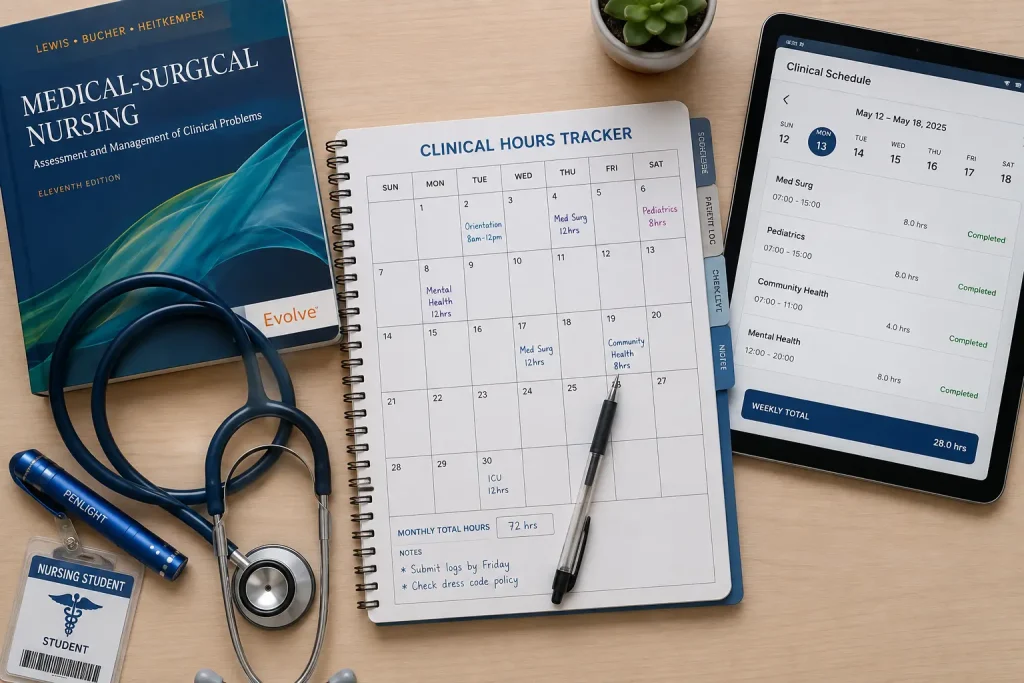
How long are nursing clinicals? Most nursing students complete somewhere between 400 and 1,000+ total clinical hours before graduation, spread across multiple semesters — and the exact number depends heavily on your program type, your state board’s requirements, and your school’s specific curriculum. There’s no single universal figure every nursing student can rely on, but there is a real, well-documented range, and this guide breaks it down by program type, semester, and speciality.
Nursing clinicals typically run 400–1,000+ total hours across your program, at roughly 15–24 hours per week once clinicals begin. ADN programs commonly run 500–900 hours over two years; BSN programs commonly run 700–1,000+ hours over four years. Your specific state board and school set the exact minimum — always confirm with your program handbook.
The Real Range: How Long Clinicals Last by Program Type
Clinical hour totals vary more than most students expect going in, and the gap between programs is real, not just a rounding difference
| Program Type | Commonly Reported Total Hours | Typical Program Length |
|---|---|---|
| LPN/LVN | ~400–600 hours | About 1 year |
| ADN (Associate Degree) | ~500–900 hours | About 2 years |
| Traditional BSN | ~700–1,000+ hours | About 4 years |
| Accelerated BSN (ABSN) | ~700–1,200 hours | 12–18 months, compressed |
A few things explain that spread. Some state boards mandate a firm minimum hour count for RN licensure eligibility. In contrast, others set requirements as a percentage of total program contact hours instead of a hard number — one published review of state board policies found mandated minimums ranging anywhere from under 200 hours to 900 hours, depending on the state. On top of that, individual schools frequently exceed their state’s floor by a wide margin: it’s common to see students from different ADN programs report totals as far apart as 500 hours and 900+ hours for what’s technically the same degree.
The honest takeaway: treat every number on this page as a realistic range, not a guarantee, and confirm your program’s actual total in your student handbook or with your clinical coordinator.
How Long Is Clinical for Nursing, Week by Week?
Once your clinical rotations begin, expect to spend roughly 15 to 24 hours per week in direct patient care, though this climbs as you advance through your program.
- Early semesters: Often a single shift per week, commonly 6–8 hours, focused on foundational skills in a lower-acuity setting like long-term care.
- Middle semesters: Typically two shifts per week, often 8–12 hours each, as you move into med-surg and speciality rotations.
- Final semester or capstone: Many programs shift you into a preceptorship-style schedule that mirrors a working nurse’s hours, sometimes totalling 120–200+ hours in that term alone.
Your school also has to convert clinical time into academic credit somehow, and most programs use a credit-to-hour ratio to do it — commonly somewhere in the range of 45 to 60 clinical clock hours per credit. However, the exact conversion your accreditor and school use can differ. That’s why two students with the same number of “clinical credits” on their transcript can end up with meaningfully different total clock hours.
Semester-by-Semester: How Clinical Hours Build Over Your Program
Nursing programs front-load classroom foundations — anatomy, physiology, pharmacology, nursing theory — before putting you in front of real patients, so your first semester almost always carries the lightest clinical load, regardless of program type.
A common progression looks roughly like this:
- Semester 1–2: Foundational skills and your first clinical placement, usually in med-surg or long-term care, at a lighter weekly commitment.
- Semester 2–3: Clinical hours increase, and speciality rotations begin — paediatrics, OB/GYN, mental health.
- Semester 3–4: Community health and additional speciality rotations round out your exposure across care settings.
- Final semester: A capstone or preceptorship experience, often your heaviest clinical load, designed to mirror independent practice under a clinical instructor’s or preceptor’s supervision.
Inside Each Clinical Rotation
For the full breakdown of what happens inside each specific rotation — not just how long it runs — see our complete guide to clinical rotations.
How Long Do Nursing Clinicals Last by Speciality?
Individual speciality rotations are typically shorter blocks within your total clinical hours, not standalone programs of their own.
- Medical-Surgical (Med-Surg): Often your longest single rotation, commonly running 6–8 weeks, since it’s usually your first speciality placement and carries the widest scope.
- Paediatrics: Commonly 4–6 weeks, reflecting a narrower but still substantial population focus.
- OB/GYN: Commonly 4–6 weeks, covering labour, delivery, and postpartum care.
- Mental Health/Psychiatric: Commonly 4–6 weeks, built around therapeutic communication rather than high patient volume.
- Community Health: Commonly 4–6 weeks, often the least hospital-bound rotation on your schedule.
These figures describe typical block length, not total hours — a 6-week rotation at 12 hours per week logs a very different total than the same 6 weeks at 24 hours per week. Check your own program’s clinical schedule for the exact hourly commitment tied to each block.
How Long Is Clinicals for RN, Specifically?
If your goal is RN licensure — whether through an ADN, diploma, or BSN pathway — your total clinical hours matter for one specific reason beyond graduation: your state board of nursing uses that hour total, alongside your coursework, to certify your eligibility to sit for the NCLEX-RN. All three RN pathways lead to the same license and the same exam. Still, they get you there on different timelines and with different total clinical hour counts, which is exactly why “how long is clinicals for RN” doesn’t have one single answer — it depends entirely on which pathway you’re in.
Diploma and ADN programs generally front-load clinical exposure earlier and often log more total hours relative to program length than a traditional BSN does. In contrast, BSN programs typically add more general education and leadership-focused coursework alongside a somewhat different clinical distribution. Neither path shortcuts the direct-patient-care requirement your state board sets — they build toward it differently.
What Affects How Long Your Clinicals Actually Take
A handful of factors explain most of the variation you’ll see between your own program and a friend’s at a different school:
- Your state board of nursing’s minimum hour requirement, which varies significantly from state to state.
- Your specific school’s curriculum, since most programs exceed their state’s floor rather than building to the exact minimum.
- Simulation-hour substitution policies, since a growing number of state boards now allow a portion of high-fidelity simulation hours to count toward your total, which can change how many hours you spend in direct patient care specifically versus simulated care.
- Your program pathway — ADN, traditional BSN, or accelerated BSN — each of which paces clinical exposure differently.
Frequently Asked Questions
How long are nursing clinicals, on average?
Most programs total somewhere between 400 and 1,000+ hours across the full curriculum, though the exact number depends on your program type and state board requirements.
How long is clinical for nursing each week?
Once clinicals begin, expect roughly 15–24 hours per week, building from a lighter single-shift schedule early in your program to a near-full-time preceptorship load by your final semester.
How long do nursing clinicals last for an ADN versus a BSN?
ADN programs commonly total 500–900 hours over about two years; BSN programs commonly total 700–1,000+ hours over about four years, though individual schools vary widely within those ranges.
How long are clinicals for RN licensure specifically?
All RN pathways — ADN, diploma, and BSN — lead to the same NCLEX-RN exam and license, but they distribute and total clinical hours differently. Check your specific program and state board for the exact number tied to your pathway.
Does simulation time count toward my total clinical hours?
In many states, yes — a portion of high-fidelity simulation can count toward your total, though the allowed percentage varies by state board. Confirm your state's current policy rather than assuming full substitution.
Continue Your Clinical & Career Research
Clinical hour totals are just the beginning. Deepen your understanding with our core guides designed for nursing and advanced practice students.
Track Your Hours with Confidence.
Master Your Nursing Clinicals.
Whether you're managing 400 hours in an ADN program or completing 1,000+ hours in a BSN curriculum, don't let hour tracking errors, state board changes, or unexpected placement hurdles disrupt your graduation timeline. XPrecepto connects nursing and advanced practice students with verified sites, clear compliance frameworks, and expert guidance.
Explore Clinical Resources & Support