How to Find a Nurse Preceptor: The Complete Clinical Search Guide
You’re staring at a deadline, a blank contact list, and a program handbook that offers no real starting point. That gap — between what you’re expected to do and what anyone actually taught you — is where this guide begins.
Learning how to find a nurse preceptor isn’t about luck or connections. It’s a process with predictable steps, predictable obstacles, and predictable fixes. This guide is the complete version — every phase of the search, in the order you’ll actually face them.
One thing this guide won’t do: promise you a shortcut that skips the real work. What it will do is make sure none of your effort gets wasted on the wrong targets, the wrong timing, or the wrong assumptions — which is where most students actually lose the months they can’t get back.
Quick Summary Table
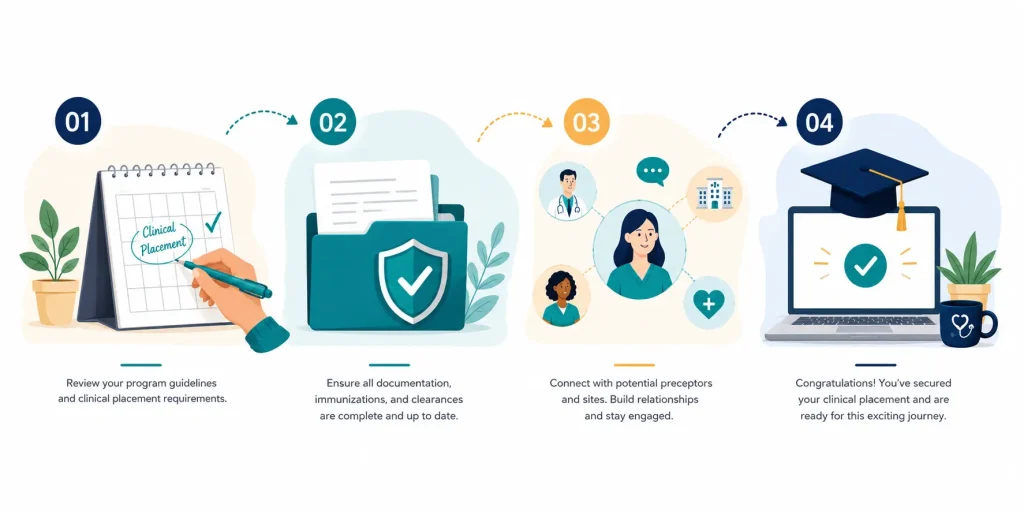
| Step | Action | Why It Matters |
|---|---|---|
| 01 | Confirm your program's exact hour, specialty, and setting requirements | Prevents wasted outreach on mismatched sites |
| 02 | Gather compliance documents (insurance, immunizations, background check) | Required before any preceptor can confirm you |
| 03 | Check which sites already have an active affiliation agreement (CAA) | Preceptors without a CAA cannot legally host you |
| 04 | Build a researched target list across multiple settings | Reduces reliance on oversaturated hospital systems |
| 05 | Send personalized, specific outreach — not generic templates | Dramatically increases response rate |
| 06 | Follow up on a structured 3-touch cadence | Keeps you visible without being pushy |
| 07 | Push credentialing forward the moment a preceptor agrees | A verbal yes isn't a confirmed placement |
Still Searching?
Let XPrecepto handle everything for you. From finding your preceptor to managing compliance, we do the heavy lifting so you don't have to.
Why This Search Feels Harder Than It Should
You’re not imagining it. This process is genuinely harder than it should be, and understanding why changes how you approach it.
NP program enrollment keeps climbing nationwide. The preceptor pool available to teach those students isn’t growing at the same pace — in many regions, it’s shrinking.
There’s a second layer most students don’t discover until they’re already searching: administrative bottlenecks — affiliation agreements, credentialing timelines, coordinator bandwidth — often matter more than the quality of outreach itself. For the complete picture, read [seven hard truths about clinical placements].
Neither of these realities is a reflection of your effort or your qualifications. They’re structural conditions every student in your cohort is navigating, whether they talk about it openly or not. The students who move through this the fastest aren’t the ones with the best connections — they’re the ones who understand the system early enough to work with it rather than against it.
If this already feels overwhelming, know that compliance-first support exists for exactly this stage of the search. More on that below.
Building Your Foundation Before You Search
Before you contact a single preceptor, you need three things confirmed: your requirements, your timeline, and your documents. Skipping this step is the single most common reason searches drag on for months.
This is where learning how to find a nursing preceptor actually starts — not with outreach, but with preparation that makes your eventual outreach land differently.
For the complete pre-outreach checklist, including the Preceptor Readiness Score diagnostic, see [the complete pre-outreach checklist]. For exact timing guidance by program type and specialty, see [the exact timeline to start on].
Before moving forward, get one document in hand: your program’s written confirmation of hour requirements, approved specialty types, and setting restrictions. Ask your clinical coordinator directly for this — see [confirming your program’s requirements] for the exact questions to ask.
Your Preceptor Search Timeline and Required Documents
Timing and paperwork are two sides of the same problem: both determine whether you’re actually ready to search, not just willing to.
Timeline by Degree Track
Your ideal starting point depends heavily on your program type:
- BSN-to-NP bridge students need the longest runway. See [the BSN-to-NP timeline] for the full breakdown.
- MSN students typically need at least 90 days. Full detail in [the MSN search timeline].
- DNP students need 90 to 120 days, more if your rotation includes a project-based component. See [the DNP search timeline].
Learning how to find a preceptor for nursing school starts with knowing which of these three timelines applies to you — the rest of your search plan builds outward from that number.
The Document Checklist
Preceptors and your school both need documentation before a placement is real:
- Updated clinical resume
- Current malpractice liability insurance certificate
- Immunization records (flu, Hepatitis B, MMR, varicella, and program-specific requirements)
- Background check from a school-recognized vendor
- Written confirmation of your program’s specific requirements
See [the full document checklist] for exact formatting and what preceptors typically ask for first.
Addressing the Fear No One Talks About
Here’s an anxiety worth naming directly: the fear that a shortfall in clinical hours could jeopardize your entire degree.
This fear is common, and it’s rarely as catastrophic as it feels in the moment. Most programs have formal extension, deferral, or make-up rotation policies specifically because placement delays are common enough to require one.
The real risk isn’t a hours shortfall itself — it’s staying silent about it. Programs can only activate deferral or extension options for students who raise the issue early. Waiting until the deadline has already passed removes options that were available weeks earlier.
If you’re worried about this right now, the single most productive move is a direct conversation with your clinical coordinator about your program’s specific extension policy — not more outreach, not more searching alone with the anxiety unaddressed.
Building a Preceptor-Ready Professional Profile
Outreach works better when you’re not improvising your own credibility in real time. Before you contact anyone, know how you’re presenting yourself.
Preceptors evaluate students quickly, often in the time it takes to read one email. See [building your clinical resume] for how to frame your RN experience as a clinical competency asset, not a job history.
Understanding [what preceptors actually screen for] before you reach out changes what you emphasize in every message. And for a complete framework tying your resume, references, and communication style together, see [your complete student profile]
How to Find a Nurse Preceptor Online and Through Your Professional Network
This is where most students start — and where most students also make their first strategic mistakes.
Casting a wide net matters less than casting an informed one. Knowing where to look, and in what order, changes your odds significantly.
- Start with [every online source worth checking] to map the full landscape of options available to you.
- LinkedIn remains dramatically underused by NP students. See [the LinkedIn strategy that works] for a step-by-step approach that bypasses gatekeepers entirely.
- If your program allows virtual clinical hours, don’t overlook [virtual and telehealth rotations] — this single option expands your geographic search to the entire country.
Searching manually across dozens of individual sites, verifying affiliation agreements one by one, and tracking responses in a spreadsheet is exactly the kind of administrative load that compliance-first services like XPrecepto exist to absorb — matching you with preceptors whose CAA and credentialing status are already verified.
In-Person and Personal Network Strategies
Digital search isn’t your only channel, and for many students, it isn’t even the most effective one.
- [Targeting local clinics and urgent care] often surfaces sites with far less competition than academic medical centers.
- If a hospital-based rotation fits your specialty, [approaching a hospital unit manager] the right way matters more than most students realize.
- Before any of the above, ask the question most students skip entirely: [asking your own workplace first]. Your current employer’s clinical network is often your warmest possible lead.
Making Contact: Outreach That Actually Gets Responses
Everything up to this point has been preparation. This is where it gets tested.
The single biggest determinant of response rate isn’t persistence — it’s specificity. A generic message gets generic silence. A specific message gets read.
Think of every message you send as competing against dozens of nearly identical requests landing in the same inbox that same week. The version that stands out isn’t the longest or the most polished — it’s the one that clearly took thirty extra seconds to say something true about that specific practice.
- [The exact email template that works] breaks down subject line, opening, ask, and close — in that order, with real examples.
- For clinics where a phone call works better than email, [a ready-to-use phone script] provides the exact structure.
- [Introducing yourself professionally] matters even in brief, informal contact moments — first impressions compound quickly in small clinical communities.
- Before you send anything, review [the 7 mistakes costing you a preceptor] — most outreach failures trace back to one of these seven, and every one is fixable in under an hour of preparation.
Staying Organized and Following Up the Right Way
A search without a system loses track of itself. This is the operational backbone that makes everything above actually work at scale.
[A simple system to stay organized] turns a chaotic, anxiety-driven search into a manageable weekly process. Pair it with [tracking every clinic and response] — a basic log of clinic name, contact method, date, and response tells you within days which strategies are converting and which aren’t.
Follow-up deserves its own discipline. [Following up without sounding pushy] outlines a structured three-touch cadence that keeps you visible to a preceptor without ever reading as pressure.
Handling Rejection and Difficult Conversations
This is the hardest part of the process emotionally, and it deserves direct, honest treatment rather than forced positivity.
Rejection in this process is rarely personal. It’s usually structural — a missing affiliation agreement, a specialty mismatch, a site already at capacity for the term. Understanding [what to say when a clinic says no] helps you respond professionally and often opens the door to a referral, even when the answer is “no.”
If you’ve accumulated several rejections and started to internalize them as a reflection of your qualifications, [the recovery plan after rejection] walks through the exact diagnostic and reset process — because in almost every case, the fix is mechanical, not personal.
If rejection is stacking up and your deadline isn’t moving, this is exactly the point where compliance-first placement support pays for itself. XPrecepto verifies affiliation agreements and specialty match before a preceptor is ever presented to you — removing the exact failure points causing most of these rejections in the first place.
Knowing When and How to Escalate
Self-managing your search has real limits, and recognizing them early protects your timeline.
[Escalating to your clinical coordinator] isn’t a last resort — it’s a resource you should engage well before a crisis point, ideally the moment your timeline crosses the 90-day mark without a confirmed site.
Understanding the real stakes helps calibrate your urgency correctly. [What a missed deadline actually costs] and [how delays affect your graduation timeline] both lay out the financial and timeline consequences in concrete terms — not to add pressure. Still, so you’re making decisions with accurate information rather than vague dread.
Verifying Compliance: The CAA Trust Layer
This section exists because almost no other guide covers it in plain language — and because understanding it will save you more wasted time than any outreach technique.
What a CAA Actually Is
A Clinical Affiliation Agreement (CAA) is a legal contract between your university and a specific clinical site. It’s what makes it legally possible for that site to host you as a student. Without one, a preceptor’s willingness is irrelevant — they cannot host you regardless of how much they want to.
How to Verify CAA Status Before You Waste Time
Ask your clinical coordinator this exact question, in writing:
“Can you confirm whether [Site Name] currently has an active affiliation agreement with our university?”
A written answer gives you something concrete to act on, and creates a record you can reference if there’s confusion later.
What to Do If No CAA Exists
New agreements can take anywhere from a few weeks to several months to execute, depending on both institutions’ legal review processes. If a site you’re excited about doesn’t have one yet, ask your coordinator directly whether initiating a new agreement is realistic within your timeline — and treat that site as a long-shot, not your primary plan, unless the answer is yes.
Why This System Exists
CAAs and credentialing requirements trace back to your accrediting body’s competency framework. NONPF competencies define the clinical skill domains your program must document you’ve practiced, and your state board of nursing’s hour requirements set the legal minimum for licensure eligibility in your state. These aren’t arbitrary hurdles — they’re the regulatory backbone that makes your eventual license valid. Understanding that context makes the paperwork feel less like an obstacle and more like a system you can work within deliberately.
Deep Dive: The Complete Preceptor Search Toolkit
Why Do NP Students Struggle to Find Preceptors? 7 Structural Reasons (2026)
Understand the systemic market failures driving the nationwide NP clinical placement crisis.
Read the Analysis
First Steps to Secure a Preceptor: The Complete NP Student Starting Guide
Stop wasting time. Follow this proven roadmap to organize your documents and secure a clinical site faster.
Read the Roadmap
How Early Should You Start Searching for a Preceptor? (180-Day Timeline)
Master the exact timeline to secure your clinical spot and avoid graduation delays.
Read the Guide
What Schools Don't Tell You About Clinical Placements: 7 Hard Truths (2026)
Discover the hidden operational bottlenecks and real-world mechanics that derail NP clinical placements.
Read the Hard Truths
Common Mistakes in Preceptor Outreach: How to Secure Your Clinical Placement
Stop the rejections. Learn how to refine your outreach and get more "yes" responses from potential preceptors.
Read the Outreach Tips
How to Write a Professional Preceptor Email (That Actually Gets a Response)
Stop sending generic emails. Learn the exact structure and tone that gets a busy clinician to reply.
Read the Email Guide
What to Do After Preceptor Rejection: A Step-by-Step Recovery Plan for NP & PA Students
Learn how to diagnose your rejection pattern and execute a recovery plan.
Read the GuideFrequently Asked Questions
How do I find a preceptor for NP school?
Confirm your program's exact requirements first, then build a target list prioritizing sites with an active affiliation agreement. Combine online research, LinkedIn outreach, and your personal professional network rather than relying on a single channel.
What do I do if I can't find a preceptor?
Run a self-audit to identify whether the issue is outreach quality, missing compliance documents, or a lack of available affiliation agreements. If your deadline is within 60 days and there is no confirmed site, escalate to your clinical coordinator or a professional placement service immediately.
Can my school help me find a preceptor?
Some schools maintain pre-approved site lists or offer coordinator support, but most place primary responsibility on the student. Ask your coordinator directly what support is actually available — don't assume based on your handbook's general language.
How many preceptors do NP students typically need?
This varies by program and specialty, but most NP programs require multiple rotations across different specialty areas, each needing its own confirmed preceptor and often its own affiliation agreement.
What is the difference between a preceptor and a clinical instructor?
A preceptor is a licensed clinician who supervises your direct patient care in a real clinical setting. In contrast, a clinical instructor is typically a faculty member who oversees the academic and simulation-based components of your program.
How early should I start looking for a preceptor?
Most students should start 90 to 180 days before their rotation begins, depending on their degree track and specialty, with earlier starts required for high-demand specialties such as psychiatric-mental health.
What happens if I don't find a preceptor in time?
Consequences range from a delayed rotation to a full semester's graduation delay, depending on your program's policies. Most schools offer deferral or extension options, but they must be requested before the deadline, not after.
Do preceptors get paid for precepting?
Most preceptors receive no direct financial compensation for teaching students, which contributes significantly to preceptor burnout and scarcity nationwide.
Is it legal to pay for a preceptor placement?
Paying a compliance-first placement service for matching, verification, and administrative support is standard and legal. Paying a preceptor directly for access varies by state and institutional policy — confirm with your program before pursuing this route.
How do I know if a preceptor is qualified?
Confirm their license type, active status, and specialty match your program's specific rotation requirements — your school's credentialing review will independently verify this before your rotation is approved.
Can I use a family member as my preceptor?
Most programs explicitly prohibit precepting arrangements with immediate family members due to conflict-of-interest and evaluation-objectivity concerns. Confirm your program's specific policy before considering this option.
How to find a nurse educator preceptor for a faculty-track rotation?
Faculty-track students should start with their program's education department or teaching faculty network, since nurse educator preceptors are typically affiliated with academic institutions rather than clinical practice sites, and the search process differs meaningfully from that of a standard clinical rotation.
You Now Know How to Find a Nurse Preceptor — Here's What Comes Next
Every section in this guide answers a piece of the same question: how to find a nurse preceptor without wasting months on avoidable mistakes.
You now have the complete sequence — foundation, timeline, documents, search channels, outreach, follow-up, resilience through rejection, and escalation. Run your [Preceptor Readiness Score] now if you haven’t already; it tells you exactly where you stand across every phase covered here.
Save This Guide for Later
Bookmark this guide. You won't need every section today, but you'll likely return to different parts of it as your search moves through each phase — the timeline math, the CAA verification script, and the rejection-recovery framework tend to matter most at different points, not all at once.
Stop Managing the Search.
Start Preparing for Success.
If your deadline is already tight, or this process has already cost you more time than you have left, XPrecepto's Placement Protection Guarantee exists for exactly this moment — a compliance-first match with a university-approved preceptor whose affiliation agreement and credentialing status are verified before you ever see their name. Get matched today, and stop managing this search alone.
Get Matched Today